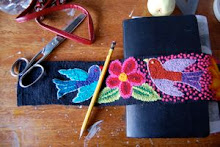
So when you look at these belts, a new meaning may emerge after you know the work behind it all.....
The background fabric... this fabric is made in a family workshop, who employees 3 other men in total. This is a mans job (as they say!)It takes one person, one day to complete the fabric for one narrow belt. An average work day is 6am to 6pm. (subtract an hour or two for lunch). Do not forget that before this sheeps wool is woven, the same men collect this wool from the local markets and do all of the dying themselves. It takes another day to dye and dry the yarn (depending on the quantity of course). This workshop also dyes and prepares all of the sheeps wool for the additional embroidery.
The embroidery on the belts....
This cooperative is comprised of about 50 women who come by weekly to pick up their surplus of yarn and woven belts to embroider. They do not have to pay for the yarn, they are paid per belt considering it is difficult to track their hours. Please note, a majority of the women walk miles to pick up the neccessary materials to embroider at the coop. It is too expensive to take taxis and they often dont even make it to their homes, which are on the hillside and impossible to drive to. The women work in the early morning and in the afternoons, until about ten a night. It varies of course. The women work when they arent busy cooking, cleaning, or taking care of their children. They average a belt a day. This seems to work for them. They all say they love their work, but need more of it!!! That is where I come in!
Thursday, January 22, 2009


Tuesday, January 20, 2009
The Design Process....
So the process of creating new designs takes time. When booking my flight, I thought one month would be overkill but it turns out that is just about right. As we all know, time is relative and in South America it takes on a new meaning. When meeting someone, that usually means that they will be at least a half hour late (or more). To find a specific type of embroidery takes days, hours on the bus, cold nights..you get the gist. It can be tiresome, but is always worth it in the end.
So these past days, Ive been working at the coop, creating new designs...bags, scarves, clutches and other accessories, using both traditional fabrics and more modern designs. This will be an experiment, but these women never seem to let me down, that is when my thoughts and ideas are clear.
So today I will be heading to the market to pick up some local fabric to turn into a soho style bag. This fabric is seen all over, usually worn by the indigenous women who use these blakets to carry anything from their babies to bundles of brush and vegetables. The vibrant stripes and embroidery work caught my eye, so Im excited to see what comes of it.
So these past days, Ive been working at the coop, creating new designs...bags, scarves, clutches and other accessories, using both traditional fabrics and more modern designs. This will be an experiment, but these women never seem to let me down, that is when my thoughts and ideas are clear.
So today I will be heading to the market to pick up some local fabric to turn into a soho style bag. This fabric is seen all over, usually worn by the indigenous women who use these blakets to carry anything from their babies to bundles of brush and vegetables. The vibrant stripes and embroidery work caught my eye, so Im excited to see what comes of it.
Friday, January 16, 2009
The Forgotten Artisans of Huancavelica, Peru
So after 8 plus hours, Yuli and I made it to the beautiful pueblo of Huancavelica which is nestled in Central Peru. I feel so blessed to be in the company of Yuli. She shares similar passions of trying to connect marginalized artisans and is the president of a cooperative which works with women who are victims of domestic violence. Seeing she is from Peru, she knows a network of artisans and has been taking me from pueblo to pueblo, connecting me to talented artisans who would otherwise be impossible to meet. Today we arrived and met an artisan by the name of Raul. He is known for his beautifully crafted alpace shawls and scarves. We spent the afternoon in his workshop, putting together new prototypes for future orders. Yuli will send all of the shipments seeing she lives in Lima. If I didnt know her, Raul would be impossible to contact. This is the beauty and frusteration which goes along with living in such an isolated pueblo.
After getting to know Raul, I got a gist for the livlihood of artisans in this area. His man concern is the fact that the government funded organization which is supposed to represent all artisans from this area have gone corrupt and taken all of the funding for themselves. They attend the gift shows in Lima but do not sell the items of these artisans. When Raul used to depend of this goverment funded organization, he would only get close to $5 for a hand made shawl which would take days to make. It is simply not worth it and he feels as though the artisans have no voice. The artisans in Huancavalica are divided. There are those that conform and those that don´t. The voices are weak and nobody listens. Being one of the provinces in Peru, the people are loosing their dignity in the sense that take what they can get for their products. Huancavlica has a plethora of incredibly talented artisans who know how to create such intricate work, but they are loosing battle after battle to be heard. Throughout the day, I felt more and more inspired knowing that I have chosen the right path within my career. These experiences encourage me to tackle the bumps within the road of starting a business.
After getting to know Raul, I got a gist for the livlihood of artisans in this area. His man concern is the fact that the government funded organization which is supposed to represent all artisans from this area have gone corrupt and taken all of the funding for themselves. They attend the gift shows in Lima but do not sell the items of these artisans. When Raul used to depend of this goverment funded organization, he would only get close to $5 for a hand made shawl which would take days to make. It is simply not worth it and he feels as though the artisans have no voice. The artisans in Huancavalica are divided. There are those that conform and those that don´t. The voices are weak and nobody listens. Being one of the provinces in Peru, the people are loosing their dignity in the sense that take what they can get for their products. Huancavlica has a plethora of incredibly talented artisans who know how to create such intricate work, but they are loosing battle after battle to be heard. Throughout the day, I felt more and more inspired knowing that I have chosen the right path within my career. These experiences encourage me to tackle the bumps within the road of starting a business.
Wednesday, January 14, 2009
La casa de Santa Raina


So I took the night bus out of Lima, taking me to a small pueblo within the central part of Peru. I traveled with the founder of the coop, Yuli, along with her parents. 15 hours later, we had arrived to our destinaion. Feeling like zombies upon our arrival we decided to rest and meet in the afternoon. I was fortunate to be picked up by the family and was taken to one of the artisans home who makes the beautiful belts. We took a taxi, over the hills, and into el campo. The houses were made of mud, the roofs of bamboo. Cacti, small gardens, burros, and chickens in the fields. We arrived to a warming house filled with good energy. To celebrate Rainas Birthday, all the neighbors came over. We were poured endless glasses of soda, chicken and rice soup, followed by goat with carrots, spinach, and white rice. The food was warming. This of course was followed by more soda and a colorful, sugary cake. The eyes of the children grew a few sizes as the cake was cut. I walked around taking notice of the cathedral adornments which are glued to the roofs, symbolizing the amount of the families whom are living in the house. It is also for prosperity and protection. I admired the simñlicity, the happiness despite the poverty. This word is so relative. We exchanged laughs and stories. Our curiousities were mututal. The view was unbelievable. I was able to see a panoramic view of all cordilleras mountains. I was filled with warm hospitality and fulfilling feeling, knowing I was getting to know the artisans in which I work and knowing they are living rich lives.
Tuesday, January 13, 2009
Back in Peru....
So I have made it back to Peru. In Lima, I begin, adjusting to the chaotic, bustling city. Yesterday, I met up with one of the founders of the cooperative in which I work. My adventures had begun. We hopped on the second class bus, heading to the outskirts of Lima. Rugged, dirt roads, concrete buildings, dust, soot, lives of hardship. 45 minutes later we had arrived. We knocked on the door, to be greeted by the producer of the horn products. With a sweet smile he invited us in, showing us the beautiful goods he and his family create out of sheared bull horn. When selling the belts, this material allows for questions, especially,¨does this harm the animal in any way.¨ TO get a good concept and idea for this process, I was grateful to see the workshop where the horn is collected and sheared. I was led to the back of the workshop, where I met Alejandros daughter, about 16 years old. She helps with the designing and held a lot of pride in her work. The smell, reminded me of a dentists office gone bad. The dust from the horn covered everything. Tones of grey filled the room.
The process is as follows. Alejandro explained that he first goes to the market to buy the horn products. He recycles the horn which would normally be thrown away. These horns are discarded from those who raise the bulls for meat. The producers used to give them away, but now they charge a small fee. A majority of the bulls horn come from the North coast, where the animals seem to be larger than in the South.
After collecting the horn, he slices them in half with a drill. He then places the halfs in a vat of boiled, bull grease which they sit in for a few minutes. This softens the material. Minutes later, he presses the horn halfs until flattened. They dry and then are cut in the specific design. He then files and polishes them for completion. The process may seem brief, but it is time consuming and tedious. He makes all of his own machinery, seeing he can´t seem to find them in town.
All in all, Alejandro is an incredibly talented artist. By the end of the afternoon, I was thrilled to have found new products, such as horn rings and bangles to sell. Each one is one of a kind. I left with a sense of excitement, for new products to come and to be able to support this family directly.
The process is as follows. Alejandro explained that he first goes to the market to buy the horn products. He recycles the horn which would normally be thrown away. These horns are discarded from those who raise the bulls for meat. The producers used to give them away, but now they charge a small fee. A majority of the bulls horn come from the North coast, where the animals seem to be larger than in the South.
After collecting the horn, he slices them in half with a drill. He then places the halfs in a vat of boiled, bull grease which they sit in for a few minutes. This softens the material. Minutes later, he presses the horn halfs until flattened. They dry and then are cut in the specific design. He then files and polishes them for completion. The process may seem brief, but it is time consuming and tedious. He makes all of his own machinery, seeing he can´t seem to find them in town.
All in all, Alejandro is an incredibly talented artist. By the end of the afternoon, I was thrilled to have found new products, such as horn rings and bangles to sell. Each one is one of a kind. I left with a sense of excitement, for new products to come and to be able to support this family directly.
Sunday, December 14, 2008
annie O. Holiday events!
Still need to do some Holiday shopping?
If so....come support annie O. and other local, socially responsible businesses where you can buy a gift with meaning, while enjoying good company, wine, and cheese!
Boulder Events...
WHAT: Bead For Life/ annie O. Craft Show
WHEN: Sat. Dec. 13th 4-6pm
WHERE: 2029 Mapleton Ave. Boulder, CO
WHAT: Bali Malas/ annie O. Holiday Trunk Show
WHEN: Thurs. Dec. 18th 4-7pm
WHERE: 944 Lincoln. Ave. Boulder, CO.
WHAT: The Boulder Holiday Gift Festival
WHEN: Sat. Dec. 21st 9am-10pm
WHERE: St. Julien Hotel 900 Walnut St. Boulder, CO
Denver Events....
WHAT: Roxy/ annie O. Boutique Trunk Show
WHEN: Fri. Dec. 12th 1-5pm
WHERE: 2628 E. 3rd Ave. Cherry Creek Denver, CO
If so....come support annie O. and other local, socially responsible businesses where you can buy a gift with meaning, while enjoying good company, wine, and cheese!
Boulder Events...
WHAT: Bead For Life/ annie O. Craft Show
WHEN: Sat. Dec. 13th 4-6pm
WHERE: 2029 Mapleton Ave. Boulder, CO
WHAT: Bali Malas/ annie O. Holiday Trunk Show
WHEN: Thurs. Dec. 18th 4-7pm
WHERE: 944 Lincoln. Ave. Boulder, CO.
WHAT: The Boulder Holiday Gift Festival
WHEN: Sat. Dec. 21st 9am-10pm
WHERE: St. Julien Hotel 900 Walnut St. Boulder, CO
Denver Events....
WHAT: Roxy/ annie O. Boutique Trunk Show
WHEN: Fri. Dec. 12th 1-5pm
WHERE: 2628 E. 3rd Ave. Cherry Creek Denver, CO
Monday, December 8, 2008
New Inspirations from Mexico.....
As I think of Mexico, I think of warm days, cold nights, cobbled stoned streets, village life, weavings, colors, textiles, smiles, balloons, tortillas, mole, cuisine, collectivos, cathedrals, confetti, fiestas, mezcal, corn, huilpes, salsa, chiles, avocados, desert, jungle, rain, coca cola, life, vibrance, zocolos, madre de tierra, cacti, and sincerity.
After traveling for about three weeks throughout the country, I felt graciously welcomed and inspired to continue my line of products, working with several other weaving cooperatives throughout Mexico. After long bus rides and miles of walking, I am excited and honored to work with these talented artisans found in smal, rural villages of Puebla and Chiapas. The follow blogs are photos and thoughts along my journey. I look forward to educating consumers on the stories and women behind these products. There is time, tradition, and dreams intertwined which is crucial to respect and not to be forgotten.
After traveling for about three weeks throughout the country, I felt graciously welcomed and inspired to continue my line of products, working with several other weaving cooperatives throughout Mexico. After long bus rides and miles of walking, I am excited and honored to work with these talented artisans found in smal, rural villages of Puebla and Chiapas. The follow blogs are photos and thoughts along my journey. I look forward to educating consumers on the stories and women behind these products. There is time, tradition, and dreams intertwined which is crucial to respect and not to be forgotten.
Subscribe to:
Posts (Atom)